
This is a developing story that we are continuing to follow and will update when more information is available.
The U.S. Army conducted a controlled detonation of unstable lead azide on Wednesday morning at the Iowa Army Ammunition Plant (IAAAP) near Middletown, Iowa, neutralizing a volatile stockpile to prevent an accidental explosion. EPA real-time air monitors are reporting zero detection of airborne lead throughout the region and never stopped collecting data throughout the event.
“Every indication is that all of the munitions that were employed absolutely reduced the lead azide threat,” said Major General Eric Shirley, Commanding General of the U.S. Army Sustainment Command. “As we saw in the immediate aftermath through overhead coverage, all of the lead aside barrels were definitively removed. There was no secondary explosions. There was no kickout. There was no infrastructure damage in or around our installation. The mister systems that were employed continued to operate throughout the detonation. There was some visible signature. I attribute most of that to the aqueous foam that we applied — over 3,600 gallons of that material was delivered by fire trucks. I believe absolutely that we reduced as close to zero as is absolutely humanly possible the risk to the health and the safety of the people of Middletown and the extended communities throughout Iowa.”
The lead azide—a primary explosive used to initiate munitions—had been held in storage drums for decades at the Middletown facility. In recent years, crystallization developed within the containers, leaving the material exceptionally sensitive to friction, movement, and temperature changes. Military and federal experts determined the chemicals were too hazardous to transport or chemically neutralize, leaving a controlled blast as the only viable option.
Emergency Measures in Place
Ahead of the detonation, Iowa Gov. Kim Reynolds declared a disaster emergency for Des Moines, Lee and Van Buren counties. The Iowa National Guard deployed 100 soldiers to assist local and federal agencies with door-to-door community outreach to approximately 150 households in the recommended evacuation area.
Agricultural leaders moved quickly to prepare rural operations in the blast’s path. USDA Under Secretary for Farm Production and Conservation Richard Fordyce coordinated with Iowa and Missouri officials to connect producers with emergency guidance.
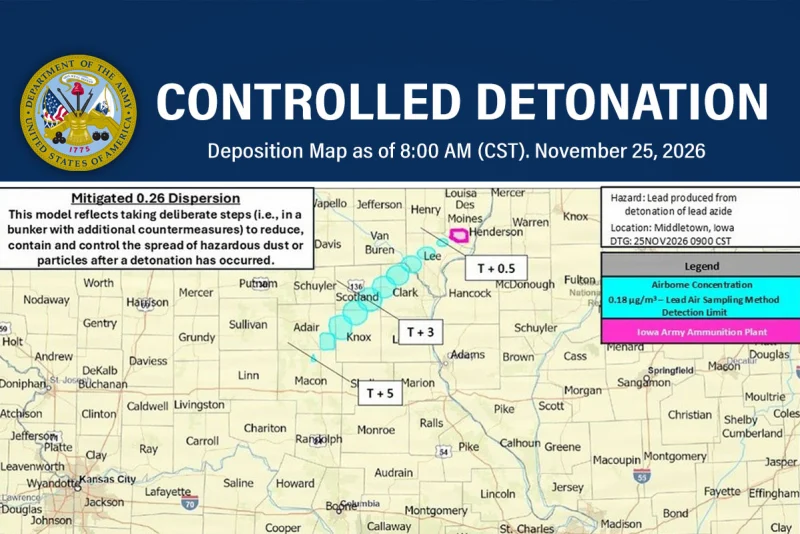
“There’s about 350 farms that could be impacted based on the direction of the plume,” Fordyce said. “Tuesday’s Army projections are showing lead dust could settle on surfaces as far as 40 miles southwest of the blast site. Airborne particles could travel about 100 miles within eight hours.”
Air and Soil Testing Ramp Up as Farmers Urged to Monitor Livestock and Forage
In response, the U.S. Environmental Protection Agency (EPA) deployed extensive field assets alongside the Army, FEMA and the Department of Health and Human Services (HHS). Members of the public looking for information from EPA should call (833)-649-9624.
“EPA’s ground response is continuing to expand, with additional teams of EPA and contract personnel being deployed, along with our emergency response resources that will include three mobile labs and one air toxics lab that are using gold standard science,” said Tom Croci, EPA associate administrator for national security and operations coordination. “EPA has been on the ground conducting independent air, water, and soil sampling and will continue until the mission is complete”.
High-altitude oversight also supported the monitoring effort. NASA mobilized research aircraft and space-based remote sensing equipment to map the plume’s trajectory and particle dispersion.
Federal and state officials urge producers who notice sudden livestock health problems, forage contamination or property damage to submit claims and request baseline environmental sampling.
Will Weather Conditions Help?
Weather conditions following the detonation may provide natural mitigation, according to meteorologist Brian Bledsoe of Brian Bledsoe Weather. He noted that incoming snow and rain forecast for Wednesday night into Thursday morning could help wash particulates from the atmosphere.
“That’s basically going to try to cleanse that dust, especially the finer particles out of the air that settles on the soil,” Bledsoe said. “And that really only remains right there in the first inch or two of that soil. The bigger thing is that whatever snow actually does accumulate settles on the ground and keeps that dust at ground level so it doesn’t get relofted if the wind actually picks back up after the storm goes away.”
Related Reading:
What is the Risk to Livestock in Iowa’s Planned Military Blast?