
Policy

A day before Trump paused tariffs on 300,000 metric tons of beef imports, WSJ reports he met privately with JBS co-owner Joesley Batista, tying the move to a firm under DOJ scrutiny as cattle producers push back.

Ground beef demand remains strong as cattle producers push back on Trump’s latest beef import plan that sent cattle prices sinking. Ranchers say consumers don’t have a beef price problem — they have a fuel price problem.

Senate Ag Committee’s 10-11 farm bill vote stalls the legislation, but a bipartisan 17-6 vote on mandatory country-of-original labeling keeps mandatory beef labeling alive for a potential September revote.

A New York farmer’s viral videos exposing pressure tactics by solar developers caught the attention of USDA’s new Special Envoy for American Landowners, John Rich, turning a local fight into a national one.

Former US Trade Representative Bob Lighthizer says Mexico, not Canada, will be the biggest test in USMCA talks, citing trade deficits. That’s as agriculture leaders push to protect billions in North American trade.

A Canadian ag policy leader says annual USMCA reviews could slow investment across North America but sees an opportunity for the U.S. and Canada to reach a win-win on dairy.

The U.S. lets the 16-year USMCA extension deadline pass, opting for rolling annual talks. Experts break down what this means for “predictability” and the leverage needed for disputes.

Sen. Boozman’s Farm Bill 2.0 bolsters farm safety nets and updates conservation programs, but notably excludes Prop 12, E15 and pesticide labeling.

New World screwworm was confirmed in the U.S., yet cattle futures rallied. An Ever.Ag analyst explains why uncertainty mattered more than the confirmation itself.

FTC chairman Andrew Ferguson announced a formal investigation Thursday into fertilizer pricing and market concentration, drawing a standing ovation from farmers representing 18 states.

Commodity markets are waiting for one key answer: Does the U.S. really have a deal with China? With only a $17 billion figure and few details, traders want proof through tariffs, export sales and purchases.

As producers navigate financial strain and D.C. disconnect, realities such as steep input costs, trade frustrations and E15 limbo are becoming decisive factors shaping the rural vote.

Diesel prices are just 20 cents from a record high, with multiple states already setting new records. Experts warn relief is uncertain as prices could remain elevated through 2026.

Despite daily volatility, cattle markets are still driven by strong demand and tight supplies. Rising fuel costs could pressure consumers, but slow herd expansion keeps the long-term outlook bullish through the decade.

In a major legislative milestone, the House-passed H.R. 7567 offers a roadmap for the next five years of American agriculture.

Ag Secretary Brooke Rollins says a multi-agency Trump administration effort will target fertilizer costs and boost U.S. production, with a major announcement expected yet this week.
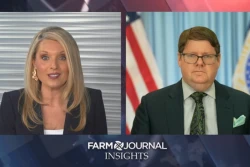
In a candid conversation with Farm Journal, USDA Deputy Secretary Stephen Vaden says USDA’s message to fertilizer companies is simple: “Be part of the solution, don’t be part of the problem.”

As the Iran war drives fertilizer prices up 40%, the Trump administration is warning against price gouging. A new survey shows only 60% of corn farmers have secured their nitrogen needs for 2026.

As make allowances surge to $5.04 per cwt., the American Dairy Coalition is demanding USDA transparency to ensure that plant efficiency gains don’t become an invisible tax on the family farm.

With labor reform at a standstill, dairy leaders warn that “he who shows up” wins in D.C., urging producers to bridge the gap between farm gate priorities and Washington’s perception.

John Deere’s Deanna Kovar details how the company is cutting parts costs, adjusting production and responding to EPA moves on Right to Repair and DEF as farm income pressure keeps the ag equipment market in a downturn.

The proclamation authorizes an 80,000 metric ton increase in in-quota lean beef trimmings imports in 2026. Economists say retail beef prices are unlikely to drop without impacting producers.

Tight cattle supplies, delayed herd rebuilding and resilient beef demand point to continued market strength, with economists saying higher cattle price highs in 2026 are still on the table.

Following Monday’s right-to-repair announcement, EPA is demanding DEF failure data from engine makers, targeting shutdowns and derates that cause costly downtime, with more DEF changes expected.

Under today’s guidance, EPA says farmers can temporarily override emissions systems to make repairs, as long as the equipment is returned to compliance, claiming manufacturers misused the Clean Air Act to block access.

As USDA and HHS rolled out a $700 million regenerative ag pilot, the real story unfolds behind closed doors. Missouri dairy farmers Jon and Brittany Hemme share what they heard and what it means for producers.

Learn how the “Make America Healthy Again” agenda and grocery inflation are reshaping voter sentiment and dairy policy ahead of the 2026 midterms.