
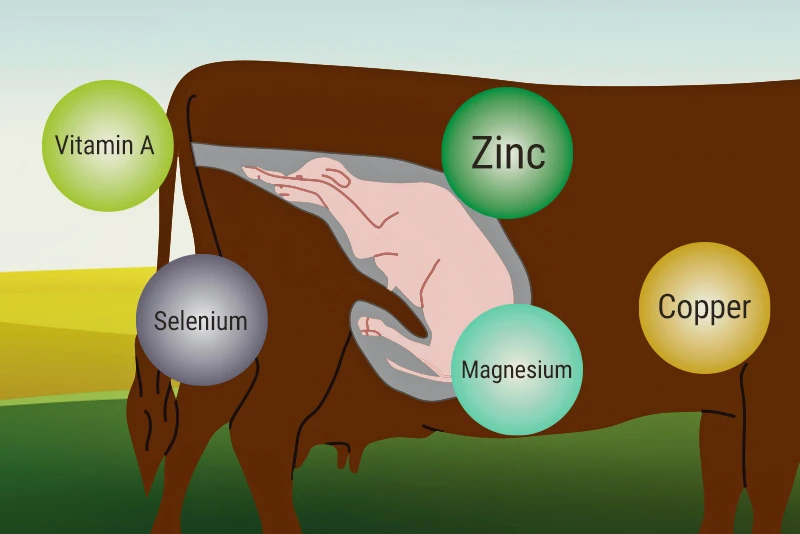
Stillbirths and weak newborn calves are among the most frustrating outcomes in both beef and dairy systems. Calving difficulty, infectious disease and congenital defects are often investigated first, yet many cases end with no clear explanation. Even when calving appears normal, losses still occur leaving veterinarians and producers searching for answers after the fact.
Dr. Bob Van Saun, professor and Extension veterinarian at Penn State University, spoke on the importance of maternal nutrition and the placental transfer of vitamins and minerals on a recent episode of AABP’s “Have You Herd?” podcast.
What often goes unnoticed is the gestational environment that shaped the fetus long before calving began. Nutritional decisions made months earlier, particularly around vitamins and trace minerals, can quietly determine whether a calf is born resilient, compromised or nonviable. Rather than being isolated calving failures, some stillbirths might represent the final outcome of inadequate fetal preparation.
“If we don’t do what we need to do nutritionally for that pregnant animal, we could have very long-term effects not only on the reproductive success of the female, but also on the offspring,” Van Saun says.
Newborn Calves Enter the World Nutritionally Limited
Newborn calves, whether beef or dairy, arrive with a biological disadvantage: milk alone cannot meet their trace mineral and vitamin needs.
“We often tout milk as nature’s perfect food, and it certainly plays a very important role in the macro minerals and in energy and protein, but one of the things that’s been well known is milk does not have significant quantities of most of the trace elements. Particularly iron, copper, selenium and even some of the vitamins aren’t in high quantities within the milk,” Van Saun says.
Trace minerals and vitamins are essential for enzyme function, immune development and antioxidant defense, yet the neonatal diet provides very little of them. As a result, the calf’s ability to survive early life depends heavily on what accumulated before birth, particularly in the fetal liver.
“With some of the work that’s been done, we’re starting to recognize that the mineral status of that newborn calf is very dependent upon how we feed mom,” Van Saun says.
In addition to gestational nutrient transfer, colostrum is an important way to get calves off on the right foot, especially with fat soluble vitamins, so long as the mother has been appropriately supplemented.
Placental Transfer of Minerals and Vitamins
Minerals and vitamins reach the fetus through the placenta, but not all nutrients behave the same way. Trace minerals appear to move primarily by facilitated diffusion, rather than active transport. Van Saun explains that as a result, fetal blood concentrations are typically much lower than maternal blood concentrations.
Once those nutrients enter fetal circulation, the liver becomes the key storage site. However, the complete mechanism by which these nutrients are stored in the liver is not well understood.
“If you remember the anatomy, the umbilical vein goes directly to the liver. It’s my thinking that the fetal liver somehow captures these minerals and stores them,” Van Saun says. “The fetal liver can concentrate these trace elements to a level that’s nearly twice what we typically see in the dam. We need to find out what influences this.”
In contrast, fat-soluble vitamins cross the placenta inefficiently, particularly later in gestation, leaving newborn calves relatively depleted at birth and heavily reliant on colostrum to establish antioxidant protection.
Maternal Mineral Deficiencies and Fetal Loss
At the Penn State diagnostics lab, mineral and vitamin analyses of fetal and stillborn calf livers have revealed a surprising number of incidences of deficiency. Despite expectations of a linear relationship between maternal mineral status and fetal mineral status, there appears to be very little direct relationship.
“When I plot maternal versus fetal concentrations, I generally see a shotgun scattergram,” Van Saun explains. “That makes me think there’s got to be some other regulatory process there.”
Across the data, several nutrients appear repeatedly in association with fetal loss and stillbirth. Van Saun highlights the following:
- Copper: Essential for enzyme systems and antioxidant defense
- Selenium: Critical for glutathione peroxidase activity
- Zinc: Involved in cellular and immune development
- Magnesium: Supports energy metabolism and neuromuscular stability
- Vitamin A: Needed for epithelial development and antioxidant defense
Oxidative Stress at Birth
As umbilical blood flow is compromised during delivery, particularly during prolonged or difficult births, the fetus experiences hypoxia.
“That’s going to produce large quantities of reactive oxygen species,” Van Saun explains. “And if those aren’t squelched by the antioxidant system, that could cause the demise of the animal.”
Trace minerals and fat-soluble vitamins play central roles in the defense against reactive oxygen species. When fetal reserves are marginal, oxidative stress during calving might push a compromised fetus past a survivable threshold. This could help explain why some stillborn calves show no obvious infectious, genetic or mechanical cause at necropsy.
Why Overfeeding Isn’t Usually the Problem
A common concern is whether aggressive mineral supplementation could harm the fetus. However, even in dams with liver mineral levels that would be considered toxicosis, fetal levels remain within a narrow range.
“When maternal concentrations of liver minerals are very low, the fetal maternal ratio is quite high. In other words, the fetus is capable of extracting more mineral from a deficient mom,” Van Saun says. “But as mom’s mineral status increases to very high levels, the ratio is quite low. Suggesting that there is some mechanism in place where the fetus doesn’t over accumulate.”
Van Suan observed this most profoundly with copper, but has also seen the same pattern with zinc, iron, selenium and manganese.
“Somehow, Mother Nature has built in a protective mechanism on both ends of the spectrum ensuring even when mom is on the low side, the fetus can try to accumulate,” he says. “And then if mom is on the high side, the fetus doesn’t over-accumulate.”
Stillborn Calves as Nutritional Sentinels
Stillborn calves represent an underused opportunity to evaluate herd nutrition. Liver mineral and vitamin analysis from stillborn calves can uncover deficiencies that were not clinically apparent in the dam.
“We really need to emphasize how to make a good situation out of a bad situation,” Van Saun says. “I think if you’re having a string of stillborns, I would be wanting to take a liver sample.”
Repeated measures of low selenium, copper, or vitamin A in stillborn calves, especially in the absence of other pathology, can point back to gestational nutrition as the root cause.
What Can You Do to Get Ahead of the Problem?
Effective investigation of stillbirths and weak calves should begin with diet evaluation, but meaningful assessment of gestational nutrition requires a broader, more deliberate strategy. A clearer understanding can be gained by using multiple diagnostic entry points across the herd and across time.
Van Saun highlights several practical diagnostic opportunities:
- Submitting liver samples from stillborn calves when infectious and congenital causes are not identified
- Using cull cow or abattoir liver samples to establish baseline mineral status
- Sampling healthy animals within defined physiologic groups, rather than sick cows in inflammatory states
- Building longitudinal data rather than interpreting isolated results
Taken together, these approaches allow the shift from reactive troubleshooting to proactive risk management.
Stillbirths and weak calves are often the final expression of biological constraints established months earlier not failures limited to the calving event.



