

“I know people are concerned about the tariffs, but the fact is, [Trump] looks at tariffs as a way to get their attention and eventually to get better and reciprocal trade agreements,” says Terry Branstad.

Uncertainty remains whether falling output in Mexico benefit the U.S. dairy industry.

Trump said he would impose a 25% tariff on imports from Canada and Mexico until they clamped down on drugs, particularly fentanyl, and migrants crossing the border, in a move that would appear to violate a free-trade deal.

As the world rapidly changes, so too does the landscape of the global dairy industry. While excitement abounds, Mary Ledman, a Global Dairy Strategist for Rabobank, emphasizes the importance of understanding the underlying drivers of market demand

Financial Times reports say President-elect Donald Trump has asked Robert Lightizer to return as U.S. trade representative.

In the ever-evolving landscape of the dairy industry, the long-term viability of the milk supply is a crucial topic. Our industry is indeed in a growth mindset akin to a fish jumping out of a bowl. This vivid imagery suggests that the industry is not merely maintaining its current status but is actively seeking ways to expand and adapt to new challenges and opportunities.

As the U.S. dairy industry continues to thrive, the critical importance of a seamless and a reliable transportation network cannot be overstated. Addressing vulnerabilities and ensuring the robustness of these transportation systems are imperative steps in sustaining the industry’s productivity.


U.S. exporters of certain cheeses and meats will continue to be able to use those terms in Chile.

Enhancing U.S. dairy exports

China launched an anti-subsidy investigation into dairy imports from the European Union a day after the bloc’s revised tariff plan for China-made electric vehicles.

Lower milk solids could mute the impact of faltering sales.
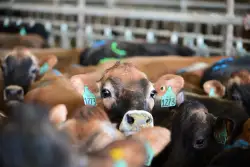
The U.S. dairy industry is poised on the brink of significant growth, as illustrated by Farm Journal’s State of the Dairy Industry report.

In a recent Farm Journal State of the Dairy Industry webinar, three leading dairy industry professionals shared their insights and perspectives about the biggest opportunities on the horizon for dairy producers.

Kathleen Wolfley with Ever.Ag spoke on a recent ‘Protect Your Profits’ webinar where she outlined many valuable insights, including five things dairy producers need to not only know, but also continue to keep a watchful eye on.
2009 dairy exports may cool; long-term prospects hot
Scarred from the volatility that has trampled the world dairy markets in the last three-and-a-half years, traders have grabbed onto Fonterra’s monthly commodity auction as a new global benchmark.
California targets the world’'s biggest dairy market
In late 2010 or early 2011, any dairy processor exporting to the European Union will need to certify that each farm that supplies milk for those exports is below 400,000 somatic cell count.
A growing number of U.S. dairy processors are expanding their exporting efforts to capture emerging opportunities abroad.
Once upon a time, all the world’s dairy suppliers wanted to sell to the U.S.
(UPDATED, Nov. 9) With the next round of NAFTA negotiations set to start in Mexico City Nov. 17, House Agriculture leaders convened a discussion that stressed the importance of the trade agreement to farmers.

Despite a pending ‘agreement in principle,’ the U.S. and Canada remain at odds on dairy issues.

Saudi Arabia is biggest market in Gulf region for Irish food.
Ireland says the United States will permit imports of beef from the country — the first European Union state allowed to resume sales since the mad cow disease scare over 15 years ago.
An inspection group from Taiwan was scheduled to arrive in Washington Sunday to monitor beef safety in the United States after a case of mad cow disease, or bovine spongiform encephalopathy (BSE), was found in a dairy cow in California last month.
The discovery of mad cow disease in the US this week could be a boon for Australia’s beef export industry but it is too early to make predictions, industry leaders say.
A BIGGER than expected drop in the US herd may offer a small reprieve for Australian beefexporters facing falls in Japan and Korea, analysis suggests.The US industry is still reeling after a USDA report counted beefcattle numbers at their lowest in 60 years.In its twice-yearly cattle report, the USDA pegged cattle and calves in the US as of January 1 at 90.8 million head, 2.1 per cent below the 92.7m a year ago and the lowest January 1 inventory of all cattle and calves since the 88.1m on hand in 1952.