
Dairy Herd

Finding a healthy work-life balance seems to be something we all strive for, but few of us ever really achieve. This balance is particularly elusive for those who are self-employed, and it’s even more challenging for those who farm for a living.

Butter continued its post-Cold Storage climb, adding $0.0225 to reach a new year-to-date high of $3.1975 per pound.

The decision was made by U.S. District Judge Lisa Godbey Wood, who found the rule unconstitutional because it conflicted with the National Labor Relations Act (NLRA) by granting collective bargaining rights to farmworkers.

Tips for producers to maximize making money now that the profit equation is finally in favor of dairy.

After ending last week with a tumble, CME cheese markets began this week with a surge, thanks in large part to USDA’s bullish Cold Storage report.

Silage samples with high ammonia (or soluble protein) consistently contain lower amino acid levels. Could subpar silage fermentation be causing this?
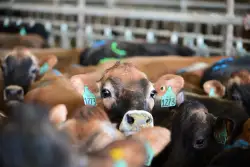
The latest USDA Milk Production Report reveals the true impact HPAI has had on dairies.

CME cheese markets tumbled well off recent highs ahead of USDA’s July Cold Storage report.

Cows that milk the same amount or more, while eating less feed than their counterparts, are both desirable and profitable. So, is there a way to “make” such cows?

Nutrition is a key driver of this incredible development and dairy can significantly impact a child’s cognitive development and overall success in life.

As parents we get these glittering moments of watching our children grow and become independent. While it’s all that we hoped they would become, it still is bittersweet.

Class III futures closed in the red, with Q4 settling at $21.23 per hundredweight, down 46 cents.

China launched an anti-subsidy investigation into dairy imports from the European Union a day after the bloc’s revised tariff plan for China-made electric vehicles.


A revered voice for the beef industry, Greg leaves behind a legacy in agricultural media and will be remembered for his dedication to the advancement of beef production during his 40-year career.

The International Dairy Foods Association (IDFA) is seeking nominations for the 2025 Innovative Dairy Farmer of the Year Award. The deadline to submit nominations is Oct. 25, 2024.

The Farmers Assuring Responsible Management (FARM) Program has released an updated version of its Animal Care standards.

Expanding your dairy farm from one location to multiple can be a game-changer for your operation. However, this leap also comes with its own set of complexities and challenges that require careful consideration and strategic planning.

Every dairy, heifer, and calf facility is no stronger than the workers who care for the animals every day. At the 2024 Dairy Calf and Heifer Association Annual Conference, managers shared ways they support workers to earn their loyalty.

Butter and cheese prices break out of the trading ranges to reach prices not seen in a while. Fall and holiday demand has kicked into gear as buyers look to Fall and holiday demand.

After last week’s fireworks, CME markets got off to a relatively quiet start this week.

Among the mix of technologies, management factors, and strategies to raise healthy calves: genetics. There is growing evidence that calves can inherit the ability to resist calfhood diseases like pneumonia and scours from their parents.

Move over, lactating ration. With its myriad of nutrition benefits and relative affordability, cottonseed makes great heifer feed, too.

Butter had the third-heaviest trade week in history, with 103 loads exchanged.

The USDA said it will expand bird-flu testing of beef entering the food supply as part of its response to the ongoing outbreak among dairy cattle, adding that U.S. beef and dairy products remain safe to consume.

Lower milk solids could mute the impact of faltering sales.
Spot butter trades reached a new record, with 51 loads changing hands – the heaviest single day since daily trading began in 2006.

The current animal traceability system and the ability to rapidly respond to a real disease outbreak is insufficient to protect ranchers and their livelihoods, says NCBA president Mark Eisele.

Learn more from the leader of the Northeast’s premier dairy farmer cooperative.

In the Upper Midwest, corn grows tall, reminding us that silage season is inching closer and closer. Some dairy farmers are fortunate to have experienced farm help on standby to assist them as they prepare for summer and fall fieldwork. Other farmers are not quite so lucky. Farm help can be hard to find. Good help that has farm equipment experience is even harder to find.