
Dairy Business News

In the ever-evolving landscape of the dairy industry, producers are facing a multitude of challenges that make growth and expansion far from straightforward.

This one-of-a-kind networking event offers a golden opportunity for both producers and businesses to share knowledge and perspectives that can help drive their dairy businesses forward.

Cory Reed, president of Worldwide Agriculture & Turf Division, spoke about layoffs, citing lower demand due to falling net farm income, higher interest rates and market volatility.

Results from Farm Journal’s state of the industry report spells significant growth.
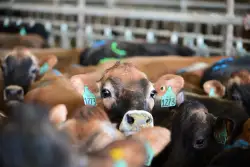
The June 2024 USDA Milk Production Report revealed a noticeable year-over-year decline in milk production across the 24 major States. Specifically, production was 18 billion lbs., marking a 0.7% decline for the month of June in the 24 major States.

Investing time now in thinking about who you hire and why you hire them will pay more dividends than most other things you can do.

Over the years, as milk moves from the farm to the plant, it increasingly carries less water. According to the USDA’s National Agricultural Statistics Service, butterfat levels continue to climb at an impressive rate.

In a recent Farm Journal State of the Dairy Industry webinar, three leading dairy industry professionals shared their insights and perspectives about the biggest opportunities on the horizon for dairy producers.

Kathleen Wolfley with Ever.Ag spoke on a recent ‘Protect Your Profits’ webinar where she outlined many valuable insights, including five things dairy producers need to not only know, but also continue to keep a watchful eye on.

A once infamous Oregon ‘mega-dairy’ site has embarked on a new journey, signaling a shift away from its controversial past.

Two young dairy producers from opposite corners of the U.S. share what excites them the most about the future of the industry, what keeps them up at night and what tools and technologies they are leaning into to help propel their dairy operations forward.

Money management is demonstrated from one generation to the next. Open and ongoing communication about the farm’s financial blueprint can help the younger generation to develop a better understanding.

Tough times lead to tough conversations. The question isn’t how do you plan to milk cows a year from now, but more likely how do you plan to milk cows decades from now?

Mastering the intricacies of data management has become a vital role on today’s operations.

Recognizing top dairy producers

Headwinds in interest rates, inflation and commodity prices seem to have little impact on land values, though single-digit decreases in Indiana, Kentucky, Michigan and Ohio have been reported.

The largest feedyard north of the Rio Grande is under construction allowing Blackshirt Feeders to combine data, technology and innovation in a closed loop aligning dairies and semen providers with the feedyard.

Beef-cross calves continue to fetch astounding values of more than $1,000/head in some markets.

As beef-dairy crossbred calves become a more widespread industry staple, they present their own set of specific benefits and challenges to the marketplace. A recently published study by Iowa State University researchers explored both.

The USDA has finally issued it’s Recommended Decision proposing to amend the uniform pricing formulas applicable in all 11 Federal milk marketing orders

The USDA will now begin accepting applications for H5N1 milk loss assistance.

The U.S. Department of Agriculture will soon begin compensating dairy farmers for the loss of milk supply due to bird flu-infected cows.

Floodwaters breached levees in parts of Iowa on Tuesday, with more flooding anticipated for Wednesday. The damage to row-crop and livestock operations is likely significant, according to state officials.

When it comes to the Farm Journal State of the Dairy Industry Report, 70% of respondents believe the dairy industry has future opportunities when it comes to innovation and processing.

“Growth in the number of larger herds will persist, but smaller farms will continue to exist in sizable numbers.”

A large percentage of dairies anticipate a need for accelerated resources and support across stewardship initiatives in the coming years. Noticeably, most lack resources for GHG and air quality metrics.

Holstein Association USA has announced John M. Meyer, CEO, will retire at the end of the year.

The Federal Reserve voted to keep the benchmark interest rate steady despite a sticky inflation proving to be a challenge. Where could interest rates go? A conversation with Austan Goolsbee, president of the Chicago Fed.
During a free Farm Journal State of the Dairy Industry webinar, leading experts will share their insights and perspectives on what the future of the dairy industry looks like and will explore every corner of dairy.

The good news is there are legal devices to do whatever a farmer wants to do. The key is using the right mechanisms for the relationship piece.