
Dairy Herd

Are the highs already in when it comes to milk prices this year, and could the heifer shortage hep propel prices in the coming year? Those are two questions we asked during the live taping of U.S. Farm Report during World Dairy Expo this year.

Randy Mooney, board chair of the National Milk Producers Federation emphasized the increasing changes impacting dairy farmers today are more seismic than ever at the recent joint annual meetings between United Dairy Industry Association, National Dairy Promotion and Research Board, and National Milk Producers Federation in Phoenix, Az.

Class III futures followed barrels downward, with the nearby contract setting at $22.72 per hundredweight.

The trend of fewer and larger is nothing new to U.S. dairy farms, and was confirmed in a recent USDA report to be continuing.

Elon Musk wants his futuristic Optimus robots to clean dishes and scrub carpets. But what if you wanted one of those creepy looking things working in your fields?

The National Dairy FARM Program is a testament to the industry’s dedication to progress, sustainability, and responsibility. Through its dynamic and customizable approach, it equips dairy farmers with the tools necessary for a sustainable future while boosting consumer confidence in dairy products.

Vanguard Renewables recently broke ground on a new renewable natural gas project at The Moyer Family’s Oakmulgee Dairy Farm in Amelia Court House, VA.

After plunging yesterday, Class III futures reversed course.

Producers are poised to increase output, but will it be enough to help feed global demand?

Milk production in the 24 major dairy-producing states saw a slight rise in September, totaling 17.5 billion lbs.

Spot prices dipped today following yesterday’s bearish Milk Production report.

A weaker milk supply has finally resulted in price strength for certain dairy products.

Kids love to imitate their parents, and Americans are certainly enamored with their coffee drinks. Now kids can have their own coffee.

In its September Milk Production report, USDA pegged U.S. milk output at 18.2 billion pounds, up 0.1% year-over-year and ahead of expectations.

Pain is a natural condition for all animals and humans. But when it comes to dairy cattle specifically, the intensity and duration of their pain can have significant influence on both their welfare and productivity.
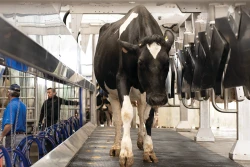
Three producers open up and share about their journey of innovation and technology as a way to spell longevity to their dairy operations.

Weekly volume trade amassed to 161 loads - the highest ever since CME started the five-day trading week.

Nine in ten parents serve whole or 2% milk to their children at home, and 81% support Congress passing legislation to allow schools to serve the same options.

Rodeo fans, it’s time to dust off your boots and grab your hats because this year’s Milk Business Conference, held at Caesar’s Palace Dec. 10-11 in Las Vegas, is taking things to a whole new level!
The dairy market is experiencing a significant transition as economic factors from 2022 carry over into 2023, impacting milk production levels. Phil Plourd, head of market intelligence at Ever.Ag, recently discussed these developments with Chip Flory, host of AgriTalk.

In September, consumer spending outpaced expectations, totaling $714.4 billion.

Creating a strong, positive culture within a team is essential for long-term success.

It has been widely observed by dairy producers and nutritionists that reduced production responses – in terms of milk yield, components, or both -- are almost a given when soybean meal is swapped out for DDGS.

Class III followed cheese prices higher, with the nearby contract settling at $22.55 per hundredweight.

Dairy farmers share passion, community spirit, and industry innovations at World Dairy Expo

Two ag industry powerhouses have announced the launch of the “Milk Sustainability Center,” a collaboration between John Deere and DeLaval.

Though spot butter prices held steady, the market was busy with trades, with 46 lots changing hands.

Producers from coast to coast pushed pause to witness the rare beauty of Mother Nature’s colorful handiwork, the aurora borealis.

Five professionals — from dairy producers to veterinarians and university Extension specialists — share some of the factors they believe have helped them and other people persevere and create a lasting career.

As agriculture faces multiple challenges, USDA’s latest net farm income forecast is masking the reality for farmers. While livestock margins have improved for 2024, high input costs and below breakeven prices for row crops means margins could be the worst in nearly 20 years.